
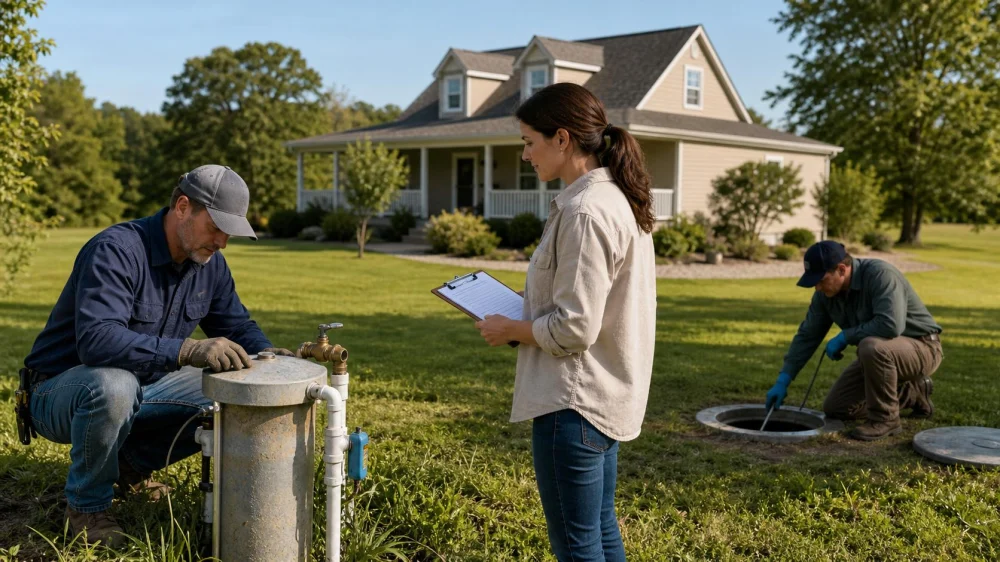
Private Well and Septic Checks Before Buying a Home
On this page
- Quick answer
- Why these systems need separate checks
- Collect records before inspections
- Evaluate the private well
- Order the right water tests
- Inspect the septic system
- Walk the property with purpose
- Use the results in your decision
- Buyer checklist
- Limitations and important notes
- Sources and evidence notes
- Frequently asked questions
- Conclusion and next steps
Quick answer
When a U.S. home has a private well and septic system, treat them as two essential property systems. Before closing, collect permits and maintenance records, hire qualified professionals to inspect both systems, and test well water through a state-certified laboratory. Make your purchase decision only after you understand defects, corrective options, local requirements, and who will pay for agreed work.
This guide is for buyers evaluating an existing home. It provides a practical due-diligence framework, not engineering, environmental, health, legal, lending, or real-estate advice for a particular property.

Avalon Brooklyn Bay / avalon brooklyn bay
1501 Voorhies Ave, Brooklyn, NY 11235, USA
Why these systems need separate checks
A private well draws groundwater for household use. A septic system treats and disperses household wastewater on or near the property. They interact with the same site, but they do different jobs and require different expertise.
Unlike a connection to municipal water and sewer, ownership usually transfers responsibility for operation, testing, maintenance, and repairs to the buyer. The U.S. Environmental Protection Agency notes that private well owners are responsible for the safety of their household drinking water, and federal public-water rules do not generally regulate private wells. Septic requirements are commonly handled by state, county, tribal, or local authorities.
A standard home inspection may identify visible concerns but may not include a complete well-flow evaluation, certified water sampling, tank opening, component testing, or drainfield assessment. Ask exactly what each inspection covers instead of assuming “utilities inspected” includes both systems.

90W Luxury Apartments / 90w nyc
New YorkNew York CountyNew York
90 Washington St, New York, NY 10006, USA
Collect records before inspections
Request documents early enough to compare them with what professionals find on site:
- Well construction log, permit, depth, type, installation date, and contractor information
- Water-test reports, treatment-equipment service records, and records of well repairs or disinfection
- Septic permit, approved design, “as-built” drawing, system type, capacity, and installation date
- Tank pumping, inspection, repair, alarm, and maintenance records
- Notices, violations, variances, easements, shared-system agreements, or access agreements
- Receipts and warranties for pumps, pressure tanks, filters, softeners, controls, or replacement components
Compare names, parcel information, system locations, and dates. Missing records do not prove a defect, but they create uncertainty. The local health, environmental, building, or permitting department may have copies of well and septic records. Ask which agency has authority before relying on a seller’s file alone.
Evaluate the private well
Hire a qualified well professional for an inspection appropriate to the property and local practice. The scope may include:
- Locating the wellhead and identifying the well type
- Checking the visible casing, cap, seals, wiring, and drainage around the well
- Evaluating the pump, pressure tank, controls, and accessible plumbing
- Testing flow, pressure, recovery, or sustained performance where appropriate
- Looking for abandoned wells that may require proper closure
- Reviewing nearby land uses or site conditions that could affect testing decisions
Turn on multiple fixtures as directed by the inspector and observe pressure, but do not treat a brief faucet test as proof of adequate supply. Well performance can vary with groundwater conditions, equipment condition, household demand, and seasonal factors. Ask the professional what the test demonstrates and what it cannot predict.
Water-treatment equipment can improve certain water characteristics, but its presence does not establish that the source is safe or that the equipment is correctly sized and maintained. Identify each device, its purpose, service schedule, consumables, and whether testing should occur before or after treatment.
Order the right water tests
Use a state-certified drinking-water laboratory and follow its sampling instructions. A seller-provided countertop strip or undocumented result is not equivalent to a properly collected laboratory sample.
The Centers for Disease Control and Prevention recommends testing private well water at least annually for total coliform bacteria, nitrates, total dissolved solids, and pH. The appropriate purchase-time panel can require additional substances based on the property’s region, geology, nearby activity, plumbing, and household circumstances. Ask the local health or environmental department and the certified laboratory what is relevant locally.
Before ordering, confirm:
- Who will collect the sample and from which fixture
- Whether treatment equipment should be bypassed or separately sampled
- Which germs, metals, minerals, or chemicals are included
- How samples must be stored and delivered
- Expected reporting time and whether it fits contract deadlines
- Who will interpret results and recommend next steps
Clear-looking, odorless water can still contain contaminants, while taste, staining, hardness, or odor may reflect issues that need different tests. Do not infer safety from appearance. If a result exceeds a health benchmark or indicates contamination, contact the health department or another qualified professional before using the water or accepting a treatment proposal.
Inspect the septic system
The EPA’s homebuyer guidance recommends having a septic system inspected before purchase. Use a qualified septic professional familiar with the system type and local inspection rules. Some jurisdictions or lenders require a transfer inspection or specific report format.
Ask whether the inspection includes:
- Review of permits, design, installation, pumping, and maintenance records
- Location and safe access to tanks, lids, distribution components, and drainfield
- Opening and inspecting tanks and accessible components
- Checking liquid levels, baffles, filters, pumps, floats, controls, and alarms as applicable
- Looking for leaks, backups, surfacing effluent, damage, or signs of hydraulic stress
- Assessing the drainfield and reserve area under local practice
- Explaining system type, current condition, maintenance needs, and limitations of the inspection
Pumping a tank may be part of the process, but a pumping receipt alone does not establish that the entire system is functioning properly. Likewise, a dye or flow test may provide limited information. Ask the inspector to distinguish observed condition from assumptions and to identify any components that were inaccessible or not tested.
Walk the property with purpose
Use records to locate the well, septic tank, drainfield, and any reserve area. Then look for site conditions that need professional explanation:
- Ponding water, unusually wet soil, sewage odor, or unusually lush patches near the system
- Vehicles, buildings, decks, pools, paving, trees, or heavy landscaping over system areas
- Damaged or low well casing, missing caps, poor drainage, or flood exposure around the wellhead
- Unknown pipes, buried lids, disconnected alarms, or improvised electrical work
- Recent grading, erosion, wildfire, flooding, or land disturbance
- Unclear access for maintenance vehicles or equipment
These observations are prompts for further investigation, not diagnoses. Do not open tanks, enter confined spaces, handle wastewater, or alter electrical controls yourself. Septic gases, unstable lids, contamination, and energized equipment create serious hazards.
Use the results in your decision
Group findings into four categories:
- Verified and acceptable: Records, inspection, and test results support continued use with understood maintenance.
- Service needed: A defined maintenance task or component repair has a clear scope and responsible professional.
- Further evaluation required: A result is inconclusive, records conflict, or a specialist, agency, engineer, or additional test is needed.
- Material decision issue: The system may be unsafe, nonfunctional, unpermitted, unsuitable for the planned occupancy, or difficult to repair under site constraints.
For each unresolved item, request a written explanation, proposed scope, permits that may be needed, and a realistic schedule. Avoid relying on verbal assurances that a filter, pumping visit, or minor adjustment will solve an unidentified problem.
Discuss contract options with your real-estate and legal professionals. Depending on the agreement and local rules, options may include additional investigation, seller repair, a credit, escrow, price adjustment, deadline extension, or termination under an applicable contingency. Do not assume a repair credit is adequate before confirming the likely scope and whether work can be permitted.
Buyer checklist
- Confirm whether water and wastewater service are private, shared, or public.
- Identify the agencies that regulate permits and transfer requirements.
- Collect well and septic permits, designs, tests, and service records.
- Hire the appropriate well and septic professionals.
- Use a state-certified laboratory for water analysis.
- Match the test panel to local risks and professional guidance.
- Locate system components and maintenance access on the property.
- Compare observed conditions with approved records.
- Get written findings, exclusions, and recommended next actions.
- Resolve safety, permitting, financing, insurance, and contract questions before deadlines.
Limitations and important notes
Inspection and sampling provide information from a particular time and scope. They cannot guarantee future groundwater levels, water quality, component life, household demand, or drainfield performance. Weather and recent water use can influence site conditions.
Rules and customary tests vary across the United States. Local authorities, lenders, insurers, and contracts may impose requirements beyond the general steps here. A real-estate agent can help coordinate the process, but technical conclusions should come from appropriately qualified professionals and laboratories.
If laboratory results raise a health concern, follow guidance from the local or state health department rather than choosing treatment solely from a sales proposal. If sewage is surfacing or backing up, keep people and animals away and contact the appropriate septic and public-health professionals.
Sources and evidence notes
- The U.S. EPA private drinking water wells resource explains that private well owners are responsible for household water safety and links to well-protection resources.
- The CDC’s guidelines for testing well water describe annual baseline testing, state-certified laboratories, and the role of local health departments in selecting additional tests.
- The EPA’s new homebuyer resources for septic systems explain how the systems work and why inspection before purchase matters.
- The EPA’s septic system questions and answers outline records and components commonly reviewed during an inspection.
Frequently asked questions
Is a regular home inspection enough for a well and septic system?
Not necessarily. Read the inspector’s scope and exclusions. A general inspection may not include certified water sampling, a sustained well-performance test, tank opening, component testing, or drainfield assessment.
Can I rely on the seller’s recent water test?
Review it, but confirm the laboratory certification, collection date, sample location, treatment status, substances tested, and chain of handling. Your contract, lender, health department, or inspector may recommend a new sample.
Does passing a water test mean the well is mechanically sound?
No. Water quality and mechanical condition are different questions. A well can produce a satisfactory sample while having pump, pressure, construction, or supply issues, and a mechanically functional well can produce water that needs further evaluation.
Should a septic tank be pumped before the inspection?
Coordinate timing with the inspector. Pumping can permit closer inspection of some components, but prior pumping can also change what is observable. Follow the qualified inspector’s process and any local transfer requirements.
What if the location of the septic system is unknown?
Start with local permit records and the approved as-built drawing, then use a qualified septic professional to locate components. Do not excavate randomly or drive heavy equipment over suspected system areas.
Conclusion and next steps
Identify the systems, collect official records, and schedule separate well, water-quality, and septic evaluations early in the purchase timeline. Convert every unclear result into a written next action before contingency or closing deadlines. The goal is not a promise that nothing will fail; it is a documented understanding of the property’s essential water and wastewater systems before ownership changes.






 Kate Lynn Realty5.0 (2 reviews)
 Sebastian Torrente at The Corcoran Group5.0 (3 reviews)
 Coldwell Banker American Homes3.0 (6 reviews)
 New York Advisory Services Inc5.0 (1 reviews)
 Arro Home Sales Realty4.0 (9 reviews)
 NY Studio Factory4.0 (28 reviews)
 How to Sell a Home Quickly Without Lowering the Price
 Understanding the Risks of Real Estate Investment
 Understanding Different Types of Home Loans: Find the Best Option for You
 Understanding the Closing Process: What to Expect
 Tips for Buying Homes With Low Credit Scores
 How to Stage a Home to Attract Higher Offers