
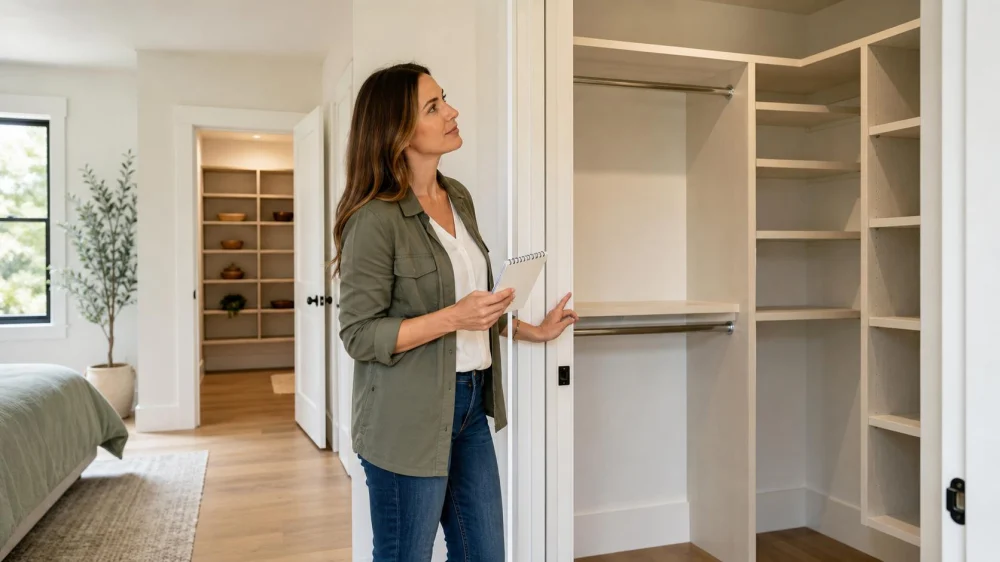
How to Evaluate Storage Space During a Home Tour
On this page
Quick answer
Evaluate storage during a home tour by comparing your actual belongings with usable shelf, rod, cabinet, and floor space in each room. Open permitted closets and cabinets, note dimensions and access, and look for moisture, odors, pests, or unsafe shelving. Treat garages, attics, and basements as storage only after checking their condition, access, and legal use.
This checklist is for U.S. home buyers comparing everyday fit. It can reveal practical limitations, but it does not replace a professional home inspection, measurements for renovation, or review of property documents.

Start with your real storage inventory
A large closet can still fail if it is in the wrong place or configured for the wrong items. Before touring, list what your household must store and where you use it. Separate daily items from seasonal and long-term storage.
- Coats, shoes, bags, sports equipment, and mobility devices near the entrance
- Food, cookware, countertop appliances, recycling, and cleaning supplies near the kitchen
- Clothing, linens, luggage, and personal items near bedrooms and bathrooms
- Tools, outdoor equipment, bicycles, strollers, and vehicle supplies
- Holiday items, documents, keepsakes, and other low-frequency belongings
Mark oversized or awkward objects separately. A vacuum, ladder, bicycle, pet carrier, or bulk food container may determine whether a space works even when its total square footage looks generous.

West 130 / 130 west hempstead apartments
West HempsteadNassau CountyNew York
130 Hempstead Ave, West Hempstead, NY 11552, USA
Measure usable capacity, not closet count
Listing descriptions often count closets but do not describe their practical capacity. On a second tour, bring a compact tape measure and ask permission before measuring. Record interior width, depth, and height, then subtract space lost to doors, sloped ceilings, utility equipment, low shelves, or inaccessible corners.
Check how the door opens. A deep closet with a narrow doorway can hide space that is difficult to reach. Sliding doors may block one side at a time, while a swinging door may conflict with furniture or circulation. In walk-in closets, confirm that hanging clothes will not make the aisle too narrow.
Look at configuration as well as volume. Adjustable shelving is more flexible than fixed shelves. Double rods may increase clothing capacity, but long garments need full-height space. Deep shelves can hold large items yet make small items disappear. Record what fits without assuming you will reorganize everything after moving.
Check storage room by room
Entry: Ask where wet coats, shoes, deliveries, keys, and everyday bags would go. If there is no coat closet, identify a wall or furniture footprint that could handle them without narrowing the walkway.
Kitchen: Open cabinets and drawers when the seller or agent permits it. Check usable depth, corner access, shelf spacing, drawer movement, and room for trash and recycling. Note whether a pantry is truly separate storage or simply a shallow cabinet. Imagine unloading groceries from the entry to their storage locations.
Bedrooms: Compare closet dimensions with the people who will use them. Confirm whether dressers can fit without blocking doors, windows, vents, or comfortable paths around the bed. A room that depends on several freestanding cabinets may have less usable floor area than it appears.
Bathrooms and laundry: Look for safe storage of medicines, toiletries, towels, cleaning products, and laundry supplies. Consider whether hazardous items can be kept away from children or pets. Check whether cabinet doors and appliance doors can open at the same time.
Garage, basement, and attic: Note temperature swings, humidity, water marks, ventilation, lighting, stairs, ceiling height, and access width. A space may be unsuitable for paper, electronics, textiles, paint, or temperature-sensitive belongings. Never assume an attic floor is designed to carry storage loads.
Look for condition problems
Storage spaces can hide signs of building problems because they receive less light and airflow. Use your eyes and nose, but do not move the seller's belongings or dismantle finishes.
- Musty odors, staining, peeling finishes, corrosion, or swollen wood
- Droppings, nesting material, damaged containers, or gaps that may indicate pests
- Loose shelves, missing brackets, sharp edges, or overloaded rods
- Exposed wiring, hot equipment, blocked panels, or storage close to combustion appliances
- Doors that bind, floors that feel uneven, or cracks that merit closer inspection
- Stored items concealing walls, floors, drains, windows, or mechanical systems
These observations are prompts for follow-up, not a diagnosis. Ask your home inspector to examine accessible areas and recommend the appropriate specialist when a moisture, structural, electrical, pest, or safety concern falls outside the inspection scope.
Estimate realistic improvement options
Some storage shortcomings are easy to improve with adjustable shelves or freestanding furniture. Others require carpentry, electrical work, ventilation changes, or structural review. Classify each idea before treating it as a solution:
- Move-in ready: Existing space holds the intended items safely.
- Simple organization: Bins, hooks, or nonpermanent shelves can improve access.
- Built-in project: New cabinetry or closet systems need accurate measurements and a realistic budget.
- Major change: Converting an attic, garage, basement, or room may involve permits, structure, insulation, moisture control, egress, utilities, or association rules.
Do not count unbuilt storage as guaranteed capacity. Verify ownership boundaries, condominium or homeowners association restrictions, easements, permits, and contractor feasibility before relying on a renovation.
Compare homes consistently
After each tour, score the same categories from one to five: entry, kitchen, bedrooms, bathrooms, laundry, utility storage, outdoor equipment, seasonal items, and accessibility. Add notes for condition and improvement cost. Photos can help only when the seller or agent permits them.
Use decision rules instead of a single total score. A home may still be a poor fit if it lacks one nonnegotiable space, such as secure bicycle storage or accessible medical-supply storage. Conversely, fewer closets may be acceptable when rooms comfortably support well-placed cabinets.
Compare storage with the home's price, location, condition, and other priorities. Avoid letting an impressive walk-in closet distract from inadequate kitchen, utility, or entry storage used every day.
Limitations and professional checks
- Tour observations cannot confirm hidden moisture, structural capacity, code compliance, or pest activity.
- Room and closet dimensions in marketing materials may be approximate; measure important spaces independently.
- Items present during a showing can conceal defects or make capacity look smaller or larger.
- Shared, assigned, or deeded storage may have separate rules, fees, access limits, or insurance implications.
- Ask qualified professionals about structural loads, electrical clearance, ventilation, hazardous materials, and conversion plans.
Frequently asked questions
How much storage space does a household need?
There is no universal ratio. The better measure is whether each category of belongings has accessible, safe space near where it is used, with some allowance for normal change. Use your current inventory rather than a generic square-foot target.
Should an unfinished basement count as storage?
Only after considering moisture, temperature, pests, access, utilities, and the type of items you plan to keep there. A basement that works for durable tools may not be appropriate for documents, fabrics, electronics, or valuables.
Can I open closets during a showing?
Closets and built-in cabinets are commonly relevant to the sale, but follow the listing agent's or seller's instructions. Do not open personal furniture, boxes, locked areas, or containers, and do not move belongings without permission.
Is a garage automatically suitable for storage?
No. Confirm vehicle clearances, door operation, water entry, temperature, ventilation, electrical and fire-safety concerns, and access to equipment. Storage should not block exits, panels, appliances, or safe vehicle use.
When should a storage issue affect an offer?
It matters when a nonnegotiable need cannot be met safely, when improvements are uncertain or costly, or when visible conditions suggest further investigation. Discuss inspection and contract decisions with your agent and appropriate professionals.
Next steps
Make a one-page inventory before your next tour. During the visit, test capacity, access, condition, and location instead of counting doors. Afterward, compare homes with the same scorecard and identify which solutions are existing, simple, or dependent on professional approval.
Sources and evidence note: This article uses general home-tour, organization, and inspection principles. It does not make claims about a specific property, building code, contract, or association. Verify material concerns through property documents and qualified local professionals.






 Charlie Huang Berkshire Hathaway | Creative Local Realtor5.0 (11 reviews)
 The Encore Property Group3.0 (6 reviews)
 Ditmas Realty Group5.0 (1 reviews)
 Victor Jung5.0 (5 reviews)
 Pep Real Estate0.0 (0 reviews)
 AKNY Real Estate0.0 (0 reviews)
 How to Negotiate Repairs After a Home Inspection: A Step-by-Step Guide
 Flipping Houses: A Step-by-Step Guide for Beginners | Start Your Real Estate Journey
 How to Sell a Home With Multiple Offers Effectively
 Tips for Buying Real Estate With Minimal Stress | Luxen House Realty Hub
 Exploring the Real Estate Market in Nashville: Trends and Insights
 Setting the Right Price: How to Value Your Home Accurately