
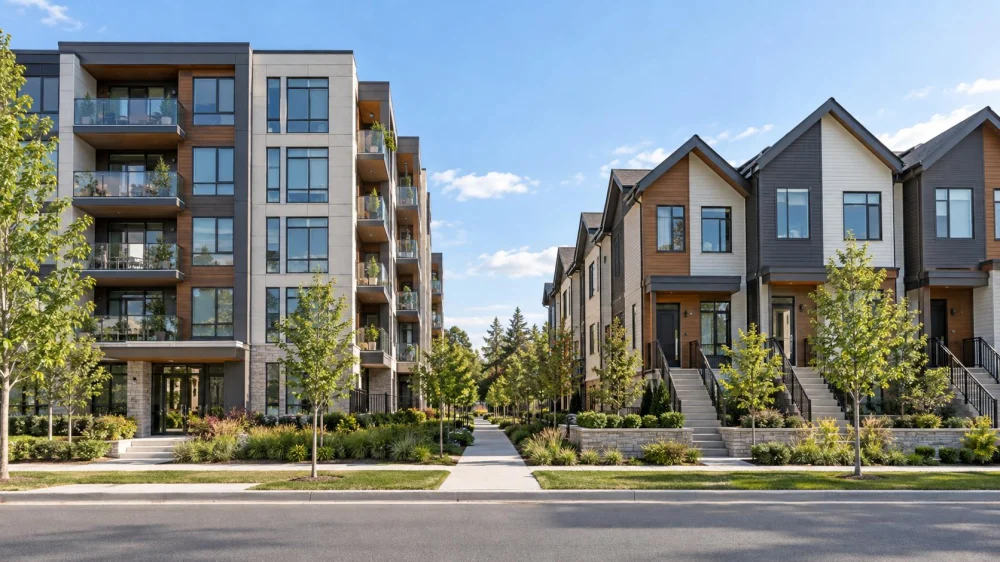
Condo vs. Townhouse: What Buyers Should Compare
On this page
Quick answer
The better choice between a condo and a townhouse depends less on the building’s appearance than on what you own, what you must maintain, and which rules and costs come with the property. Review the deed, association documents, budget, insurance responsibilities, and maintenance boundaries for the specific home. Choose only after comparing the total obligation—not just the sale price or monthly fee.
A condominium describes a form of ownership in which a buyer typically owns an individual unit plus an interest in shared elements. A townhouse describes an attached, multi-level housing style and may be legally organized as a condominium, a planned community, or another ownership form. Because labels in listings can be imprecise, buyers should verify the recorded documents.

Prism at Park Avenue South Apartments / prism at park avenue south apartments
New YorkNew York CountyNew York
50 E 28th St, New York, NY 10016, USA
Start with the ownership documents
Two homes that look like townhouses can assign ownership very differently. One buyer may own the structure and land beneath it, while another may own only the unit boundaries defined in a declaration. Likewise, a property marketed as a condo may be detached. The legal documents—not the shape of the home—usually establish the rights and obligations.
Ask an appropriate real estate professional or attorney to help identify:
- The exact unit or lot boundaries and whether land is individually owned.
- Which walls, roof, foundation, windows, doors, utilities, parking spaces, yards, and balconies are part of the unit or shared property.
- Any easements, limited common elements, access rights, or exclusive-use areas.
- Voting rights and how the association allocates expenses.
- Whether the description in the listing matches the deed, declaration, plat, and other governing records.
Compare maintenance responsibility
Maintenance is often the practical difference buyers feel most. In many condominiums, the association handles substantial exterior or common-area work. In some townhouse communities, the owner may be responsible for the roof, exterior walls, yard, driveway, or utility lines. Neither pattern is universal.
Create a boundary checklist for each property. Mark who repairs and who pays for the roof, siding, windows, plumbing leaks, pest damage, landscaping, snow removal, shared roads, fences, drainage, and exterior insurance. Then inspect the condition of owner-maintained items and common property. A lower association fee may simply mean the owner pays more costs directly.
Also ask how an urgent problem that crosses unit boundaries is handled. Water intrusion, shared plumbing, or structural work may involve several owners, the association, insurers, and contractors. Clear procedures and well-defined responsibilities can matter as much as the physical condition.

Review fees, reserves, and assessments
Compare the full housing cost: mortgage payment, property taxes, association fees, utilities, insurance, expected maintenance, and possible assessments. A monthly association fee is not automatically good or bad. Evaluate what it includes and whether the association appears to be planning for predictable major repairs.
Request the current budget, recent financial statements, reserve information, insurance summary, and recent meeting records when available. Look for planned projects, repeated maintenance deferrals, delinquent dues, active loans, and recent or proposed special assessments. Ask whether fees have changed and whether another increase is under discussion.
Reserve studies and budgets are planning tools, not guarantees. A well-funded reserve may still face an unexpected loss, while a smaller association may use a different funding strategy. Buyers should understand the trade-off and obtain professional review when the documents are complex.
Match the rules to your lifestyle
Shared communities can restrict changes and uses that owners of detached homes might take for granted. Read the current declaration, bylaws, rules, architectural standards, and enforcement policies. Pay particular attention to pets, parking, rentals, guests, noise, exterior changes, home businesses, electric-vehicle charging, and use of outdoor space.
Consider daily experience as well. Condos may offer more shared amenities or centralized maintenance, while some townhouses offer a private entrance, multiple levels, or outdoor space. Those are common patterns, not promises. Visit at different times if practical and evaluate stairs, accessibility, sound transfer, parking, storage, deliveries, and the route from the vehicle to the door.
A practical decision framework
Use the same five-part test for every property:
- Ownership: Can you clearly explain what the deed conveys?
- Responsibility: Can you identify who maintains and insures every major component?
- Financial exposure: Can your budget handle dues, owner maintenance, and a possible assessment?
- Control: Are the use and renovation rules compatible with your plans?
- Resale fit: Do lending, insurance, rental, or occupancy limits affect your likely future buyer pool?
A condo may be best for a buyer who values shared maintenance and accepts collective rules. A townhouse with broader owner responsibility may suit someone who wants more control and can manage exterior upkeep. Avoid choosing by label alone.
Limitations and important notes
Real estate forms, association laws, disclosure duties, and document-review rights vary by state and community. Building design also does not determine legal ownership. This article provides a comparison framework, not legal, tax, lending, insurance, engineering, or investment advice.
Use qualified local professionals for the property and decision: a real estate agent for market process, an attorney for legal documents where appropriate, an inspector or specialist for condition, a lender for financing eligibility, and an insurance professional for coverage. Do not assume that association insurance covers the unit interior, personal property, improvements, loss assessments, or every cause of damage.
Sources and evidence notes
This guide reflects common U.S. real estate due-diligence practice: confirm ownership from recorded and governing documents, map maintenance duties, review association finances and rules, and obtain property-specific insurance and lending information. No universal cost or appreciation claim is made because outcomes vary by market and community.
Frequently asked questions
Is a townhouse always fee simple ownership?
No. “Townhouse” usually describes architecture, not a single legal form. Review the deed, declaration, plat, and title information to determine what is conveyed.
Do condos always have higher association fees?
No. Fees depend on services, amenities, insurance, reserves, property size, and maintenance responsibilities. Compare what is included and which costs remain with the owner.
Which type is easier to finance?
Eligibility depends on the borrower, property, ownership structure, association, occupancy mix, insurance, and loan program. Ask a lender to review the specific property early.
Who insures the exterior?
The answer comes from the governing documents and policies. Request the association’s insurance information and ask an insurance professional what individual policy and coverage limits you need.
Can I rent out either property?
Possibly, but association rules, local law, lender requirements, and insurance terms may limit rentals. Verify current restrictions and approval procedures before relying on rental income.
Conclusion and next steps
Compare a condo and a townhouse by ownership, maintenance, total cost, rules, and future flexibility. For each candidate, collect the legal and association documents, build a responsibility checklist, obtain financing and insurance guidance, and investigate condition. The property that fits is the one whose obligations you understand and can comfortably manage.





 Flat Iron Real Estate4.0 (2 reviews)
 New York Lex0.0 (0 reviews)
 Worldwide Realty New York LLC0.0 (0 reviews)
 Cushman & Wakefield0.0 (0 reviews)
 Tronos Realty LTD4.0 (120 reviews)
 Kevin Bethel, RE/MAX In The City5.0 (15 reviews)
 Home Offer Contingencies: Match Deadlines to Your Risks
 Comparable Home Sales: Questions Before You Rely on Them
 How to Evaluate a Neighborhood Before Buying – Tips for Making an Informed Decision
 How to Interview a Real Estate Agent Before You Hire
 Understanding Foreclosed Homes and Their Investment Risks
 How to Renovate Homes to Increase Market Value | Luxen House Realty Hub