
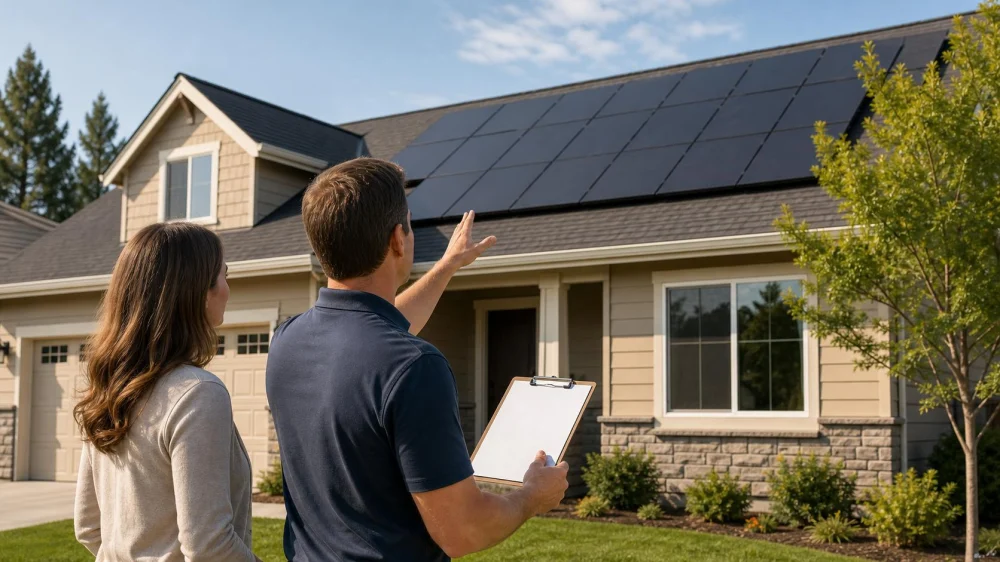
Buying a Home With Solar Panels: What to Verify
On this page
Quick answer
Before buying a home with solar panels, determine who owns the equipment and whether a loan, lease, or power purchase agreement must be paid off or transferred. Review the signed contract, bills, warranties, permits, utility approvals, roof condition, and service history. Have the lender, title company, insurer, qualified inspector, and contract provider confirm requirements before contingency and closing deadlines.
A residential solar arrangement is the combination of equipment ownership, financing or service contracts, utility connection, warranties, and property rights attached to a home energy system. Two homes with similar panels can create very different costs and obligations, so visible equipment alone is not enough to judge value.

787 Seventh Avenue / 787 seventh avenue new york
New YorkNew York CountyNew York
787 7th Ave, New York, NY 10019, USA
Identify the solar arrangement
Ask the seller to state the arrangement in writing and provide supporting documents. Common structures include seller-owned equipment with no debt, equipment financed by a loan, a third-party lease, or a power purchase agreement in which the homeowner buys energy produced by a provider-owned system.
- Owned outright: verify proof of ownership, warranties, permits, and whether any security interest remains.
- Solar loan: identify the borrower, current balance, payoff terms, collateral, and whether the obligation or lien will be cleared at closing.
- Lease: review payment schedule, escalation terms, remaining term, transfer qualifications, buyout options, maintenance duties, and end-of-term choices.
- Power purchase agreement: review the energy rate, annual changes, remaining term, minimum obligations, transfer process, and purchase options.
- Property tax assessment financing: ask whether an assessment remains on the property and how the lender and closing agent will treat it.
Do not rely on phrases such as “paid solar,” “panels included,” or “no electric bill” without documents. “Paid” might mean a current payment was made rather than the full obligation being satisfied.

Prism at Park Avenue South Apartments / prism at park avenue south apartments
New YorkNew York CountyNew York
50 E 28th St, New York, NY 10016, USA
Review the complete document set
Request records early because the seller, installer, financing company, system owner, and utility may each hold different information.
- Original purchase, loan, lease, or power purchase agreement and all amendments
- Current payoff, buyout, or transfer statement from the responsible company
- Equipment list with panel, inverter, battery, and monitoring components
- Installer workmanship and manufacturer warranty terms
- Building and electrical permits, inspection signoffs, and utility permission to operate
- Recent electric bills and available system production reports
- Maintenance, repair, roof-removal, and reinstall records
- Homeowners insurance information related to the system
- Any notices, claims, liens, UCC filings, assessments, or unresolved service issues
Confirm that names, property address, equipment identifiers, payment terms, and system size agree across records. A missing document does not prove a problem, but it creates a question that should be resolved before the buyer accepts the obligation.
Check the system and roof
A general home inspection may observe accessible solar components but may not evaluate electrical performance, design, mounting, production, or contract compliance. Ask what the inspection includes and whether a qualified solar or electrical professional should conduct a separate assessment.
Review visible panel condition, mounting points, roof penetrations, conduit, disconnects, inverter status, battery location, labeling, and signs of water entry or unpermitted changes. Never climb on the roof or open electrical equipment yourself.
Compare the roof’s age and expected remaining service life with the solar arrangement. If roofing may need replacement, determine who may remove and reinstall the panels, whether that work affects warranties, and what it may cost. Obtain actual quotes for the property instead of using a generic estimate.
Evaluate energy records carefully
Solar production does not equal household savings. Bills reflect consumption, rate plans, fixed charges, credits, weather, shading, occupancy, electric vehicles, batteries, and utility rules. The seller’s usage pattern may be very different from the buyer’s.
Compare at least several recent bills with corresponding production reports when available. Look for seasonal patterns, unexplained outages, a monitoring system that is offline, or production that differs materially from seller representations. Ask the utility which rate plan and credit structure currently apply and whether they transfer to a new account.
Do not assume a tax credit, rebate, renewable-energy certificate, or net-metering arrangement will transfer. Program eligibility and ownership of incentives depend on current rules and contracts. Consult a qualified tax adviser or program administrator for buyer-specific guidance.
Coordinate financing and transfer
Tell the mortgage lender about the solar arrangement early. The lender may need to review payments, liens, assessments, transfer terms, insurance, and ownership of equipment. A buyer who must qualify for a lease or power purchase agreement may need separate approval from the provider.
Ask the title or closing professional to identify recorded interests and confirm the agreed payoff, release, assumption, or transfer steps. The purchase contract should state who is responsible for fees, approvals, arrears, repairs, and documents—and what happens if the transfer cannot be completed.
Before closing, obtain written confirmation from the relevant company that all required forms, credit reviews, signatures, and payments are complete. Confirm how monitoring access, warranties, utility accounts, and customer-service contacts will be handed over.
Solar-home buyer checklist
- Identify whether the equipment is owned, financed, leased, or under a power purchase agreement.
- Collect the original contract, amendments, payoff or transfer statement, and payment history.
- Review permits, utility approval, warranties, equipment list, and service records.
- Compare electric bills with production reports and ask about the applicable utility rate plan.
- Evaluate roof age, mounting, electrical components, and battery safety with qualified professionals.
- Ask the mortgage lender, title company, insurer, and provider about their requirements.
- Put payoff, assumption, repairs, fees, and deadlines in the purchase agreement.
- Verify final approvals and releases before closing.
- Transfer monitoring, warranties, utility service, and emergency contacts at handoff.
Important notes and professional triggers
Pause for professional review if the seller cannot produce the contract, the equipment owner is unclear, a lien or assessment appears, the roof needs near-term work, the system lacks permits or utility approval, production records show unexplained gaps, or a provider says the buyer does not qualify for transfer.
Solar contracts, utility programs, building codes, real estate disclosures, tax treatment, and lending rules vary across the United States and change over time. This guide is general buyer education, not legal, tax, engineering, insurance, lending, or investment advice.
Do not operate disconnects, open an inverter or battery enclosure, or access a roof without appropriate training and authorization. Damaged electrical equipment, exposed wiring, heat, smoke, unusual odor, or water intrusion around energized components warrants prompt professional safety guidance.
Frequently asked questions
Do solar panels automatically increase a home’s value?
No automatic result applies to every home. Ownership, contract terms, system condition, roof life, utility rules, local buyer demand, and market evidence all matter. A local real estate appraiser or agent can explain relevant comparable sales without guaranteeing a premium.
Can a solar loan stay with the house?
It depends on the loan and transaction. Some obligations may require payoff, while other arrangements may have an approved transfer path. The lender, creditor, title company, and mortgage lender should confirm the permitted treatment in writing.
What if the seller cannot find the solar contract?
Ask the seller to obtain a complete copy from the installer, owner, or finance company. Do not rely on a verbal summary when payment, transfer, warranty, or equipment-ownership obligations remain uncertain.
Should a home inspector inspect solar panels?
Ask the inspector to define the scope. A standard inspection may be limited to visible conditions and may recommend a specialist. Choose additional assessment based on the system type, age, records, roof, and any observed concern.
What should be transferred after closing?
Typical items include utility service, monitoring credentials, provider account, warranty registration, maintenance contacts, manuals, and records. The exact handoff depends on the contract and equipment; confirm it before the seller loses account access.
Sources and evidence notes
This guide reflects common real estate, lending, title, inspection, and residential solar due-diligence practice: identify ownership, read the operative agreement, reconcile payments and records, evaluate roof and equipment condition, and coordinate transfer before closing. The signed contracts, utility tariff, permit record, lender requirements, title documents, and current federal, state, and local rules control a specific transaction.
Next steps
Ask the seller for the solar document package as soon as the property becomes a serious option. Write the system’s ownership model, remaining obligation, transfer deadline, roof age, and missing records on one page. Send that list to the appropriate real estate, lending, title, inspection, insurance, tax, and legal professionals while contract protections are still available.






 RIPCO Real Estate LLC0.0 (0 reviews)
 Danny Brown-Agboh - Charles Rutenberg Realty5.0 (2 reviews)
 CBRE5.0 (1 reviews)
 AJ Clarke Real Estate4.0 (249 reviews)
 Coldwell Banker American Homes4.0 (4 reviews)
 Regus - New York City - One Liberty Plaza4.0 (7 reviews)
 Is It a Buyer’s Market in 2025? Analyzing Current Real Estate Trends
 Understanding the Legal Process of Selling Real Estate | Luxen House Realty Hub
 The Benefits of Smart Home Technology for Home Buyers
 How to Make Smart Real Estate Investment Decisions: Tips for Success
 The Benefits of Hiring a Local Real Estate Agent
 How to Buy Property in Areas With High Appreciation Rates